
At 11:48 UTC on Wednesday 14 October, the biggest single move our Whales tab had logged in the previous 24 hours was $75.5 million of ETH. It left a wallet labelled Coinbase Prime and landed in a wallet nobody has named.

A typical whale-alert account would post that as "$75.5M of ETH withdrawn from Coinbase" and leave you to assume someone just bought. Maybe they did. But Coinbase Prime is the custody and trading service large institutions use, so the same transfer fits a fund moving coins to its own storage, a client settling an over-the-counter trade, or Coinbase rearranging where it keeps client money. The transfer is a fact. The story attached to it is a guess.
That is the real problem with tracking whale wallets. Seeing the transfers is easy; any block explorer shows them. Knowing what they mean is the hard part, and it comes down to four questions.
A whale is a wallet, and a wallet is not a person
Every transfer on a blockchain runs between addresses. An address can belong to one person, to an exchange holding coins for millions of customers, to a fund, or to a smart contract. One large holder usually spreads coins across many addresses, and a single exchange wallet can hold more than any individual whale ever will.
So the first question for any big transfer is never "how much?". It is "whose wallets are these?". Without a name on at least one side, a $75 million transfer tells you that $75 million moved, and nothing else. This is why the naming of wallets is most of the work in whale tracking, and why a tracker that shows you raw transfers without names is showing you the easy half.
Direction matters more than size
Once you know who is on each side, the useful question is whether the coins are moving towards a place where they can be sold, or away from one.
Onto an exchange means coins that can be sold within minutes. A cluster of large deposits is the closest thing on-chain data has to sell pressure. Off an exchange means coins heading somewhere they cannot be sold instantly; repeated over days, that is what accumulation looks like. A transfer between two private wallets, on its own, usually tells you very little.
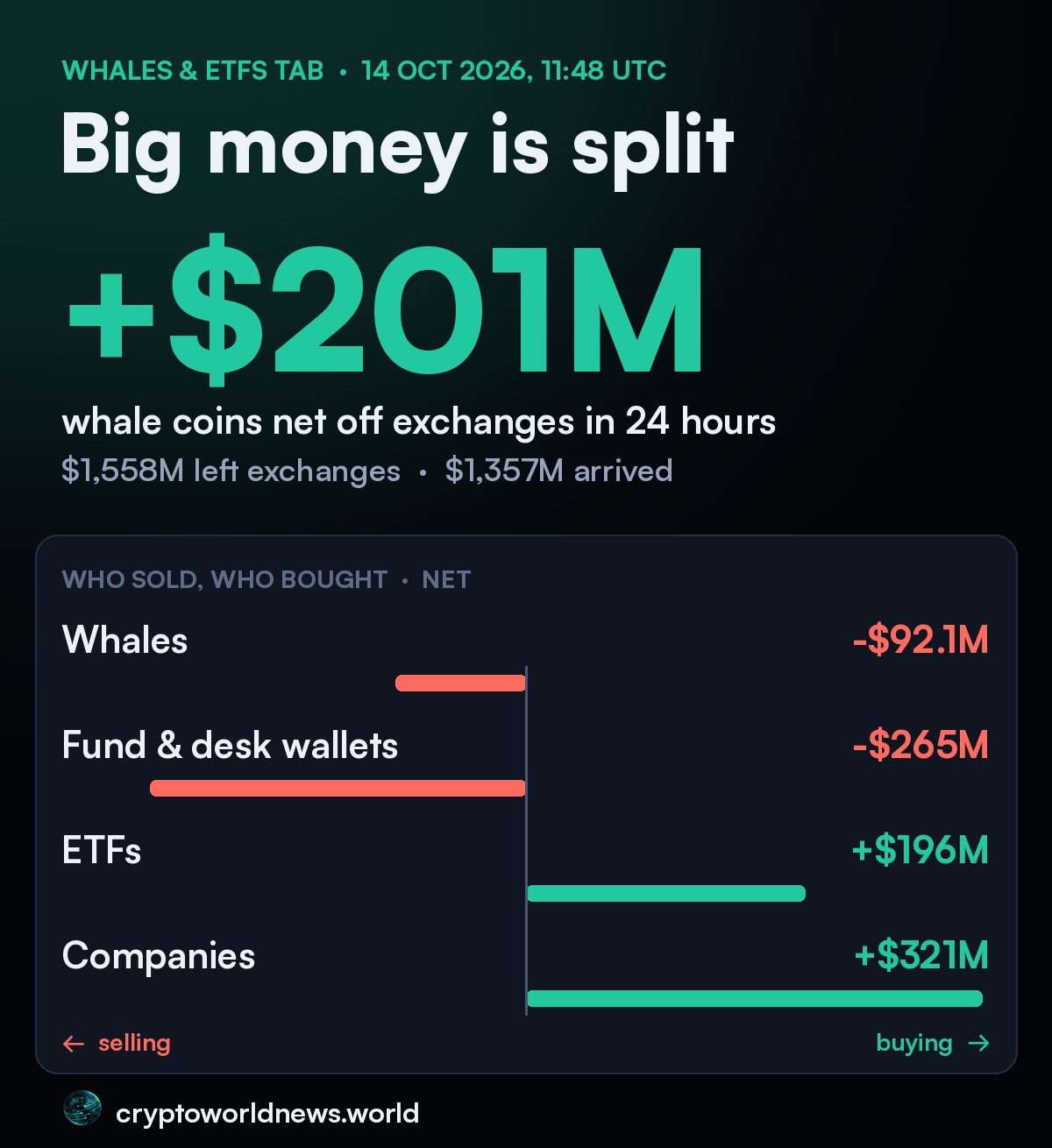
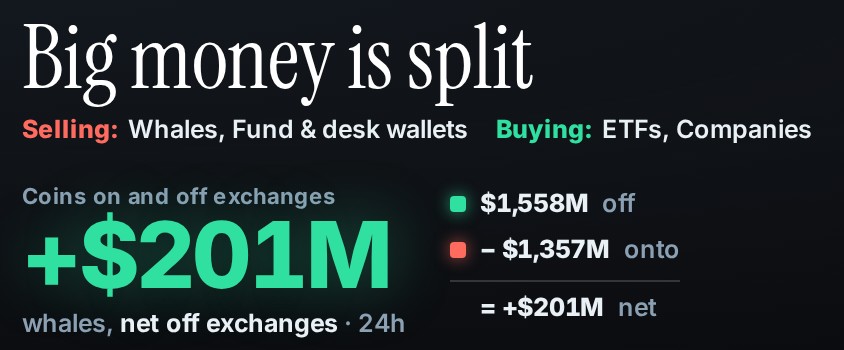
On Wednesday the Whales tab counted $1,558 million of whale-sized coins leaving exchanges in 24 hours and $1,357 million arriving. Neither side means much alone; both are mostly traffic. The difference, a net $201 million off exchanges, is the number worth watching from one day to the next.
Big money is not one crowd
"Whales" lumps together players with very different reasons to move coins, so the tab splits them up. On Wednesday the groups disagreed:
- Whales (large wallets, trades and transfers): net sellers, -$92.1 million. That is mid-range for the last 32 days.
- Fund and desk wallets: net sellers, -$265 million, in the bottom 15% of the last 120 days.
- ETFs (flows filed for 12 to 14 October): net buyers, +$196 million.
- Companies: net buyers, +$321 million over one day.
The verdict at the top of the panel read "Big money is split". That is a more honest summary than any single figure. Note too that it measures something different from the $201 million: the net figure counts coins moving on and off exchanges, while the verdict nets what each group bought and sold. When funds and desks sell while ETFs and companies buy, billions can change hands while the price barely moves. Bitcoin was up 0.24% over the same 24 hours.
What gets left out matters as much as what counts
Any whale total contains moves that look enormous and mean nothing. An exchange shifting coins from one of its wallets to another can be worth a billion dollars and is not a trade, so the Whales tab leaves out moves where both sides belong to the same exchange. A move into or out of an exchange wallet we track does count, even when we cannot name the other side, because the exchange side is what makes it a deposit or a withdrawal.
Transfers between two wallets nobody has named are the hardest case. For Bitcoin, we follow the coins one more step. If they land on an exchange next, the original move counts as a sale. If the sending wallet was funded from an exchange, it counts as a purchase. Anything we still cannot place stays neutral. A smaller number we can stand behind is worth more than a bigger one we guessed.
How to track whale wallets yourself
You can do all of this by hand. Paste an address into a block explorer, read its history, and work out from its counterparties who it probably belongs to. It works well for one wallet. It does not scale to tens of thousands of moves a day across dozens of chains, and the naming is where nearly all the time goes. On Wednesday the Whales tab logged 63,953 moves in 24 hours, worth $22.02 billion.
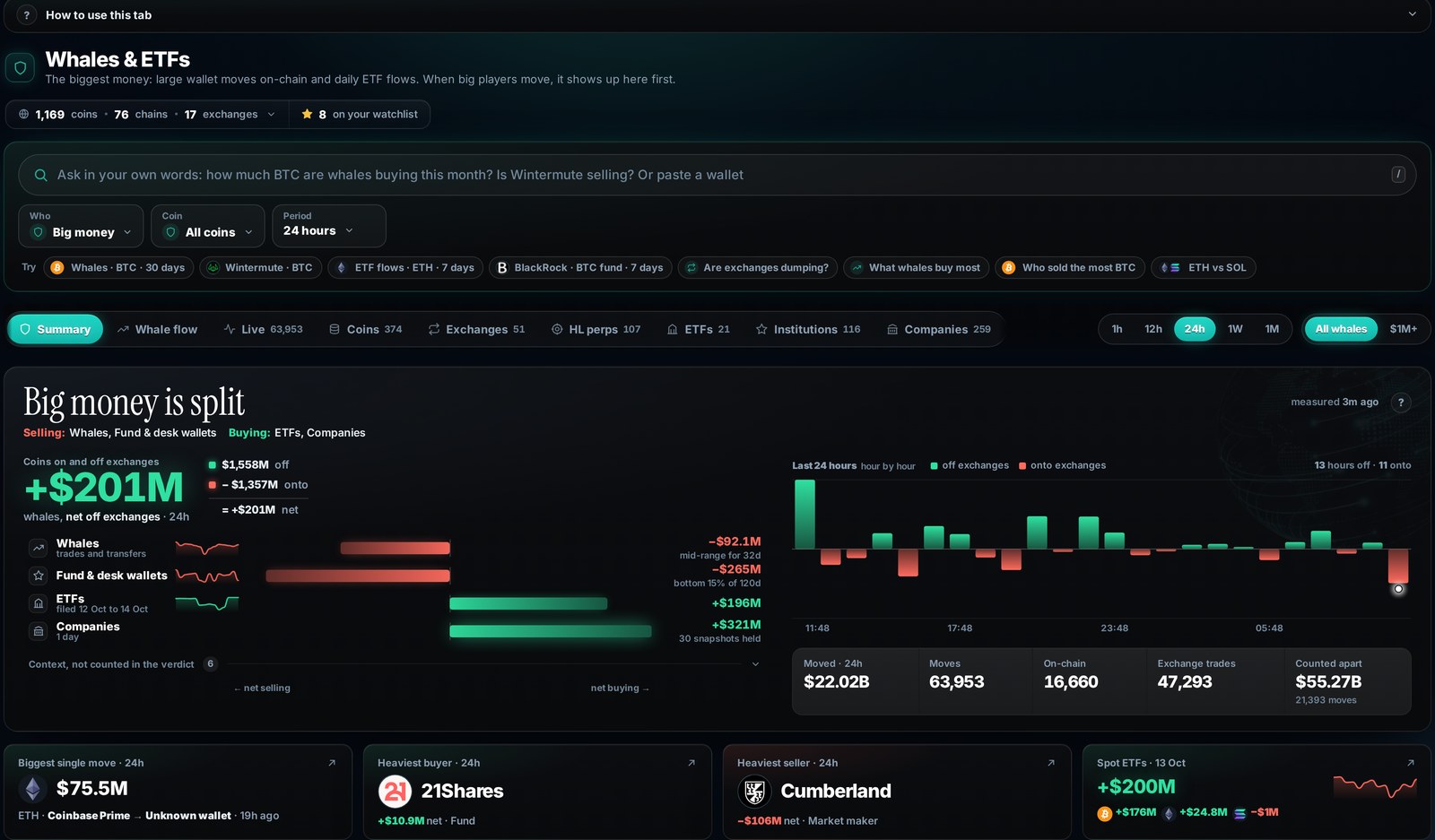
Here is how we would use the tab day to day:
- Start with the Summary. The verdict line and the net figure answer the first question: is big money buying, selling or split? Switch the window between 1 hour, 12 hours, 24 hours, a week and a month to see whether today is unusual.
- Ask in plain words. The search box takes questions like "how much BTC are whales buying this month?" or "is Wintermute selling?", and you can paste a wallet address or a transaction hash straight into it.
- Click a wallet. A named wallet opens to show who it is and what it did, which is the step a block explorer cannot do for you.
- Change the lens. Whale flow, Exchanges, ETFs, Institutions and Companies each cut the same money a different way. HL perps shows live leveraged positions on Hyperliquid, the one venue that publishes them. Those are bets, not coins being held.
- Set an alert. Whale alerts start at $5 million by default, and you can set the threshold anywhere from $100,000 to $1 billion.
As of Wednesday the tab covered 1,169 coins across 76 chains and 17 exchanges, plus issuer-filed ETF flows and company filings.
What whale tracking cannot tell you
Even a perfectly labelled transfer leaves gaps. Trades negotiated directly between desks often settle in ways that never show up as a clean on-chain move. A deposit to an exchange can be collateral for a loan rather than a sale. And no wallet tells you its owner's cost price or time horizon.
That is why whale data works best as context. A net outflow alongside rising funding and climbing open interest says something; the same outflow on its own says much less. Read the flows, check them against the rest of the market, and treat any single transfer, however large, as a question rather than an answer.
Every figure in this post comes from the Whales & ETFs tab, which nets whale-sized moves across 76 chains and 17 exchanges with ETF and company flows, and names the wallets behind them. Start a free 7-day trial, no credit card required. £14.99/month while founding spots remain, £24/month after. 14-day money-back guarantee.
Related reading
- What whale movements actually tell you (and what they don't). The four things a big transfer can be, and why the alert alone is not a trade.
- How to read on-chain crypto data without getting fooled. The wider toolkit, beyond whales.
- The Crypto Desk, Ep. 2: Longs Pile In While the World's News Splits. The same Wednesday's numbers, in our weekly video.