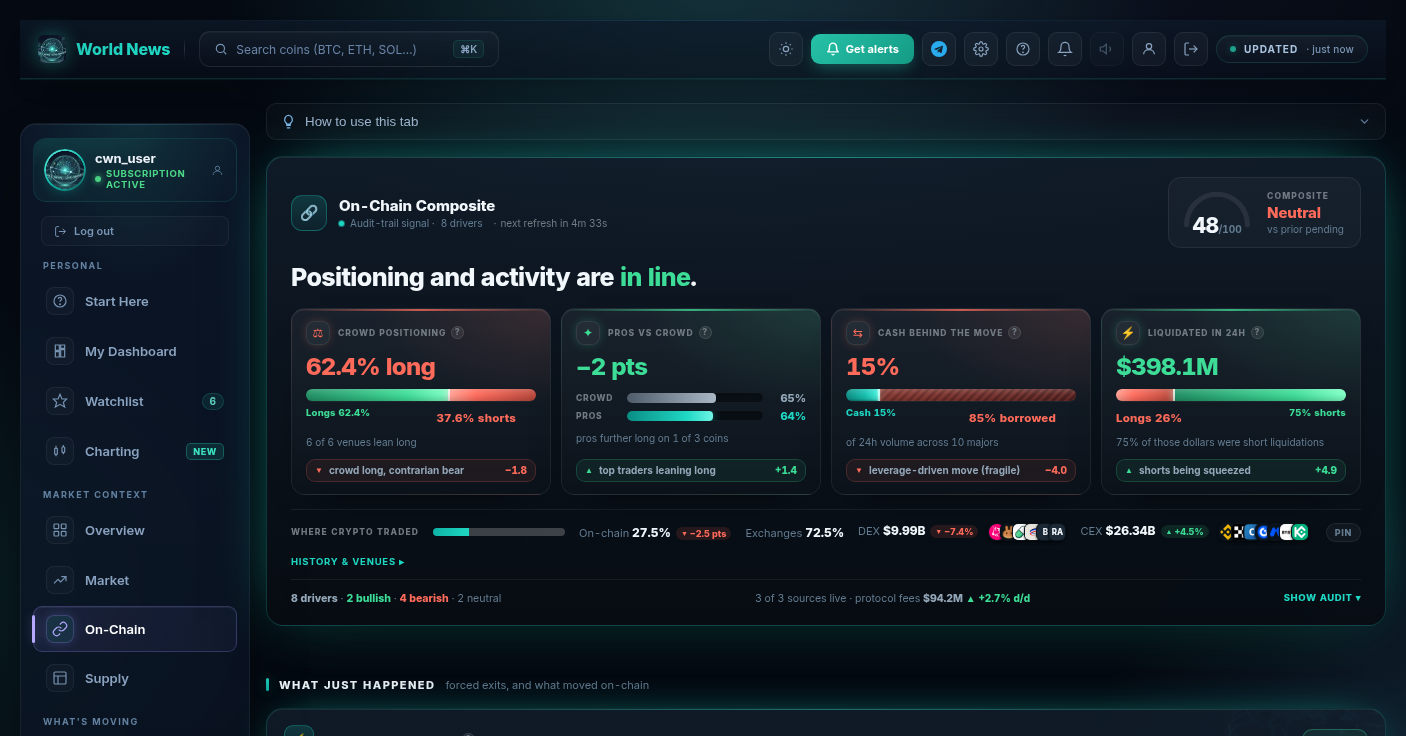
The screenshot above is the On-Chain tab on cryptoworldnews.world on 11 September 2026. The composite reads 48 out of 100, neutral. Under it, four driver tiles: the crowd is 62.4 percent long, top traders sit 2 points less long than the crowd, only 15 percent of the day's volume was real cash, and $398.1M was liquidated in 24 hours, three quarters of it shorts. The footer counts 8 drivers, 2 bullish, 4 bearish, 2 neutral.
Four traders looking at that single screen could reach four different conclusions. The positioning reader sees a crowded long. The liquidation reader sees shorts being squeezed, which is bullish. The cash reader sees a move running on borrowed money. The valuation reader sees Bitcoin holders sitting on a 44 percent gain, nowhere near a top. Each one is correct about their own card. None is correct about the market. That gap is the whole problem this tab is built to solve.
What on-chain data is, briefly
On-chain data is the public record of what the blockchain has done: transactions confirmed, addresses active, miners paid, coins moved onto and off exchange wallets. Valuation ratios like MVRV are derived from that record. Derivatives data (open interest, liquidations, funding, long/short) comes from the exchanges instead, but it belongs on the same screen because it describes the leverage sitting on top of that record.
Read carefully, the two together show the conditions that produced the current price. Read carelessly, the same screen will justify any conclusion you bring to it.
The four drivers, in order
Crowd positioning, 62.4 percent long, bearish. The share of all tracked accounts positioned long, blended across six venues, and every one of the six leans long. A crowded long is a contrarian read: those positions are the fuel for the next flush. The tile counts it minus 1.8 toward the score.
Pros vs crowd, minus 2 points, bullish. Top accounts are 64 percent long against the crowd's 65 percent. Nearly level, so the tile only adds plus 1.4. When the two split wide, the crowd is usually the side that ends up squeezed.
Cash behind the move, 15 percent, bearish. Spot volume as a share of spot plus perp volume across ten majors. Fifteen cents of every dollar traded was real cash; the rest was borrowed. Leverage-driven moves unwind fast, so this counts minus 4.0.
Liquidated in 24 hours, $398.1M, bullish. Seventy-five percent of those dollars were short liquidations. Shorts being squeezed is forced buying, so this one adds plus 4.9, the largest single contribution on the screen.
The strip under the tiles says where the trading happened: 27.5 percent on-chain, down 2.5 points on the day, $9.99B through decentralised exchanges (down 7.4 percent) against $26.34B through centralised ones (up 4.5 percent), with the venue logos behind each figure.
The nine cards under them
Liquidations. The 24-hour total, which side took the hit, and a live tape of the last five minutes. Search any coin to get its own figures. The ladder below shows where the next liquidation pools sit above and below today's price for the coins you pick, so you can see what a 5 percent move in either direction would force.
Exchange net flow. Whale-sized transfers on and off exchanges in the last 24 hours, in dollars. $2.02B moved on the day of the screenshot, and it was nearly a dead heat: $954M left exchanges into wallets, $1.06B arrived where it can be sold. The card names the biggest movers each way and the drill lists every coin.
Spot vs perp. The same cash share as the driver tile, by coin, with a 30-day line. Bitcoin was 14 percent cash, Ether 12, Solana 16. None of the ten majors was above 28.
Long/short ratio and pro traders. Positioning per venue and blended, with taker buy against sell pressure, then the top accounts' long share by coin against the crowd's.
Open interest. Dollars in open perp positions across 18 venues, by coin, with the one-hour change and funding. Rising open interest with a rising price is conviction; rising open interest with a flat price is leverage building. Search any coin for its own venue split.
MVRV, 1.44. Bitcoin's market value divided by what holders paid on average, from Coinmetrics. Holders are up 44 percent and the break-even price is $53,200. Readings in the high threes have marked cycle tops; readings near 1 have marked bottoms. 1.44 is neither.
Miner revenue, $38 per petahash per day. Hash price from mempool.space block reward and fee data. Fees were thin, subsidy carried the day, and the next difficulty adjustment was pointing up, which squeezes margins. Sustained drops here have preceded miner selling.
Network activity, 629k daily transactions. Cooling: 14 percent fewer transactions a day than the 30-day average. A price rising on falling use is thin.
Who is building on it. Collapsed by default. Weekly commits per chain from GitHub, with stars, and the latest closed governance votes.
How the composite is built
Eight drivers go into the score. The four tiles are the positioning and leverage drivers; the audit under the score lists all eight with value, sign, weight and source. "3 of 3 sources live" means every external fetcher answered this cycle. When one does not, the card says so instead of printing a zero.
Funding rates, ETF flows and stablecoin supply live on their own tabs and feed those composites instead. The number on this tab only reflects what is visible on this tab. No hidden inputs.
How the deltas earn their keep
Every figure on the tab carries its change: against the prior reading for the composite, against yesterday and the 30-day average for volumes and flows, against the 14-day average for liquidations. Every change is coloured by what it means, not by its sign. Rising short liquidations print green because they are forced buying. A rising share of borrowed money prints red because the move is fragile.
That is what stops the single headline number from lying to you. A composite of 48 that arrived from 60 is a different market from a composite of 48 that arrived from 35, and the deltas are what tell you which one you are looking at.
What the chain does not tell you
The on-chain record is the on-chain record. It does not tell you what a fund's redemption schedule looks like next week. It does not tell you what an exchange treasury team is doing across its own internal wallets. It does not tell you OTC flow, which by definition happens off the public ledger.
It also does not tell you which direction price will go in the next hour. None of these readings is predictive on that timeframe. They are contextual. They tell you what the underlying conditions are, not where the next candle will print.
That is worth saying clearly because the way on-chain data gets sold on Twitter is mostly fake. "On-chain says top is in" is a tweet, not a thesis. The chain says holders are sitting on a certain aggregate gain, miners are earning at a certain rate, the network is being used at a certain volume. Translating any of those into a price call is the reader's job, and the call gets a lot more reliable when several unrelated reads agree.
The takeaway
Most of the time the composite sits in neutral and the correct response is to ignore it. You do not trade every reading. You wait for several drivers to flip the same direction at once, or for the chain to disagree sharply with price, and then you act.
If there is one practical thing to take from this whole post: stop reading on-chain charts one at a time. Either look at four of them together, or do not bother looking at any. One MVRV chart screenshot is the same as one headline from CoinDesk. It feels like information and it is not.
The On-Chain tab on CryptoWorldNews runs eight live drivers with a full audit trail, weighted into one composite, with every figure on the tab carrying its own change and colour. Start a free 7-day trial, no credit card required. £14.99/month while founding spots remain, £24/month after. 14-day money-back guarantee.
Related reading
- What "signal confluence" actually means (and why one signal is never enough). The same stack-the-evidence logic the On-Chain composite uses, applied across the nine-dimensional per-coin signal score.
- What whale movements actually tell you (and what they don't). The four different things a big on-chain transaction can mean, and why most whale-alert reactions are reading the wrong one.