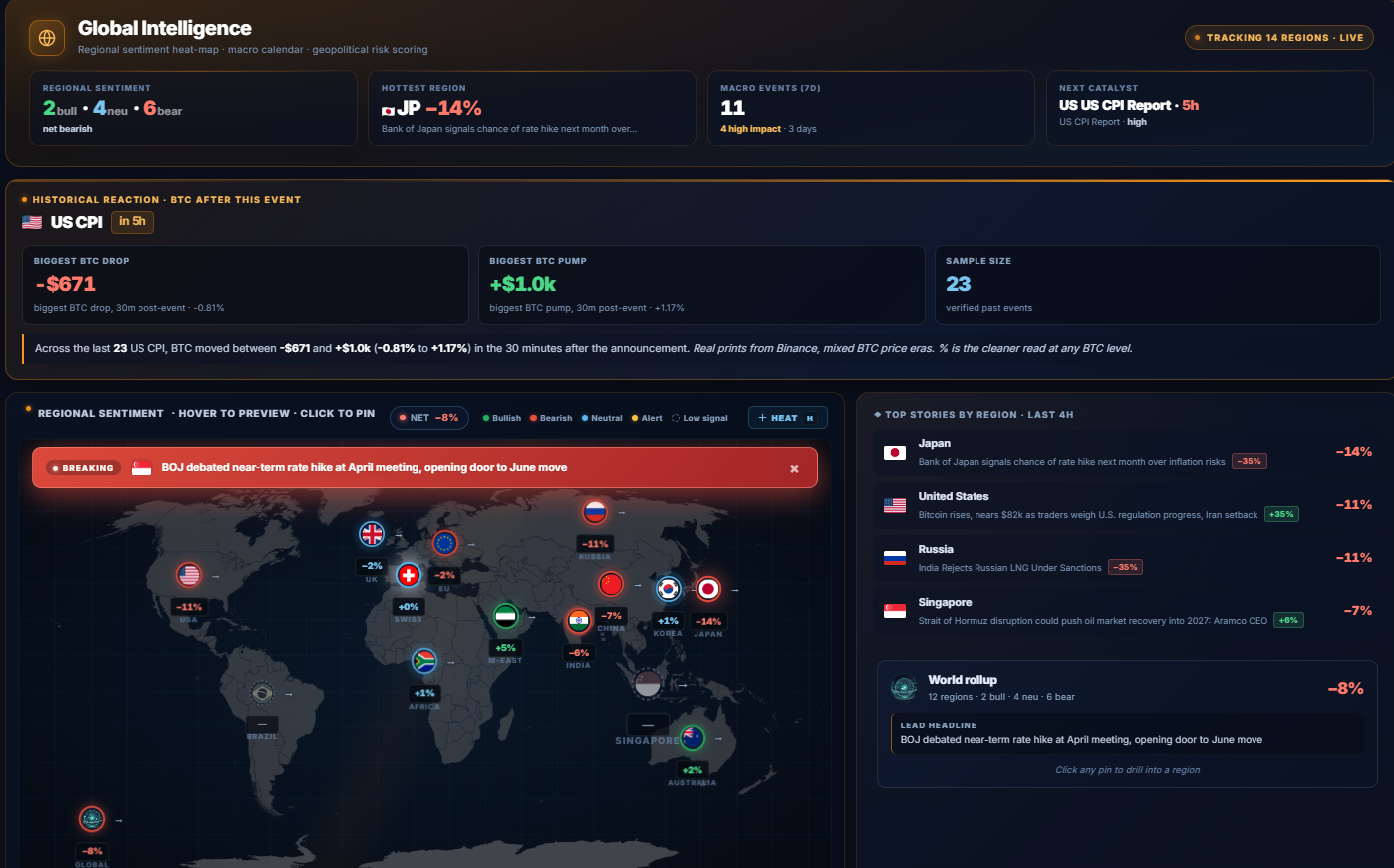
Crypto trades twenty four hours a day, seven days a week, with no closing bell. Every region is a market. Every timezone has its own news cycle, its own dominant exchanges, its own retail cohort, and its own reasons to buy or sell. There is no single "home" for Bitcoin. It belongs to all of them, all the time.
That is the problem with watching one news feed from one country. The move you keep missing is not happening where you are looking. It is happening somewhere else, in a different language, on a different cohort's screens, and by the time it shows up in your feed, the trade is already done.
Crypto is genuinely global, and your feed probably isn't
Different regions trade different things, on different venues, in different hours. Korean exchanges like Upbit and Bithumb have a long-running track record of trading alts at meaningful premiums to global prices when local retail piles in. Japanese exchanges like bitFlyer and Coincheck attract more conservative, majors-focused flow. US exchanges centre Coinbase, the Bitcoin spot ETFs, and the institutional desks behind them. Asian retail wakes up while Europe is asleep, and Europe trades while New York is at lunch.
This is not a hypothetical structural curiosity. It is how the market works every single day. When you only watch your local feed, you are choosing to see eight or twelve hours out of the twenty four. The move that gaps your chart at 6am happened somewhere live while you weren't looking.
The same headline isn't the same trade in every region
A regulatory announcement reads differently depending on which desk frames it first. A constructive licensing regime out of Singapore is treated as a tailwind. The same kind of headline framed by a state news desk in a country with capital controls reads as confirmation of stricter enforcement. Both framings are real. Both move price. They do not move it the same direction or at the same speed.
Geopolitical stories show the same pattern. Conflict headlines treated as generic risk-off in Western media get a different framing when the desks are inside the affected region, with very different downstream effects on local stablecoin demand, regional exchange volume, and how fast the story actually moves money. A trader watching only Western coverage sees one narrative. A trader watching the regional coverage sees the cohort that's actually trading on it.
You cannot price the move correctly if you only see one half of how the news is being read.
The headline isn't the trade. The positioning into the headline is
The cleanest, oldest rule in market trading is that price moves on the difference between what the news says and what was already priced in. The corollary nobody states clearly is that the priced-in part usually got priced in somewhere else, at a different hour, in a different language. Regional positioning into a scheduled high-impact print runs for hours before the release. If you only track your local news cycle, by definition you are reacting to the last fraction of a move that's mostly over.
This is why catching CPI prints, central bank decisions, and major regulatory events from a single-region feed almost always feels like a coin flip. The data point is the same for everyone. The positioning into it isn't, and that positioning is what you needed to see.
What good global coverage actually has to do
Most "global crypto news" sites are an English-language aggregator with country flags in the URL. That's a translation layer, not coverage. Real global coverage has to do three things that almost no product does in one place.
It has to score regional sentiment, not just list regional headlines. Counts are dumb data. Knowing that there are fifteen new stories out of a region is noise. Knowing the net sentiment, where that sits relative to the region's own baseline, and the size of the move from the last few hours, is signal.
It has to surface the cohort behaviour, not just the cohort's news. The coins a regional cohort actually trades when sentiment moves matters more than the headline that moved it. The same story lands very differently on a market dominated by US institutional flow than on one dominated by Korean retail.
It has to calibrate to history. A headline alone is information. A headline plus "the last N times an event like this happened, BTC moved between X and Y dollars in the first thirty minutes after" is a trade plan. Without the historical envelope you're guessing the range. With it, you're sizing inside a known distribution.
You cannot watch fourteen feeds in fourteen languages. You shouldn't have to
The reason most traders give up on global coverage isn't that they don't believe in it. It is that the cost of doing it manually is unmanageable. Fourteen language feeds, fourteen cultural contexts, fourteen sets of regional jargon, no shared scoring. By the time you have read across all of it the move is done.
CryptoWorldNews pulls news from over a hundred and fifty sources across fourteen regions, runs it through a common sentiment model, normalises the scoring, and lays it on a single live map. Click any region and you get the verdict, the headline that's moving it, the upcoming macro events for that region, the historical BTC reaction to similar events, the coins that regional cohort tends to trade, and one-tap pivots to peer regions. The work that used to be fourteen feeds and a translation budget collapses into one tab and a click.
That isn't a feed. It's the part of the workflow most retail skips because doing it by hand was never realistic. Start a free 7-day trial, no credit card required. £14.99/month while founding spots remain, £24/month after. 14-day money-back guarantee.