
ETF approved. Bitcoin up 5% the day before the announcement, flat on the day, down 8% over the following week. Then everyone wonders why the "bullish catalyst" made them lose money.
This isn't a bad example or a fluke. It's one of the most consistent patterns in crypto over the last five years, and it repeats every time there's a genuinely big headline. By the time the news breaks publicly, three things have already happened: the rumour was priced in over days or weeks, informed money built positions into the expected move, and the final leg before the announcement squeezed out every remaining short. The headline is the exit, not the entry.
Retail reads the headline and reacts. Professional money sold the headline to retail. That's the gap, and it's been the same gap for a long time.
The problem with "buy the rumour, sell the news" isn't that it's cliché
It's that most people know the phrase and still trade the news anyway, because the headline feels too obvious to ignore. The brain wants "exchange hacked" to mean short and "spot ETF approved" to mean long. It's a very hard instinct to override, even after watching it play out dozens of times.
A cleaner model: a headline isn't information, it's confirmation of information that was already trading. The day a central bank announces a cut isn't the first day anyone expected a cut. The day a regulatory ruling drops isn't the first day the market knew roughly what the ruling was going to say. Markets don't move on news. They move on the difference between the news and what was already priced in.
Which means trading a headline direction, blind to what price has already done, is basically trading the last ten per cent of a move that's mostly over. Sometimes you catch a clean continuation. Most of the time you're the last person in.
Watching the reaction tells you far more than reading the headline
The useful information isn't in the news itself. It's in how price behaves against the news.
Good news, price up , expected. Nothing to act on. Good news, price flat or selling , the news was priced in and the move is done. Often the start of a meaningful correction. Bad news, price down , expected again. Bad news, price flat or bidding back , now that's worth paying attention to. The market just absorbed a reason to sell and refused. That's a real signal about underlying strength, and one of the cleaner setups you can get.
The other thing worth doing is waiting. The first hour after a major headline is almost entirely noise , algos front-running, stops clearing, liquidity thin. The second and third hours are where the real direction shows up, once the flow settles and the market reveals how it actually wants to interpret the event.
News as confirmation, not trigger
The practical version: look at the data first, then the news, not the other way round.
If confluence across funding, whale flow, open interest, and sentiment is already bullish, and then the news flow starts confirming it , that's tailwind. Size up. If the data is neutral or bearish and the news is "bullish" , be careful, the headline might be a distribution catalyst rather than an entry. If the data is strongly one way and the news is strongly the other , sit on your hands. You're between two opposing forces and the outcome is noise.
A good news tape doesn't find trades for you. It confirms or cancels the ones you'd already considered from the data. Flipped the other way round, you spend your life reacting to headlines and getting chopped up in both directions.
The edge isn't in being first to a story. It's in not being fooled by one.
Here's what this looks like in practice. The dashboard runs a curated news engine across 55+ sources and condenses it, every 30 minutes, into a plain-English brief of what the flow is actually doing , not a list of headlines, but a read of what the headlines add up to:
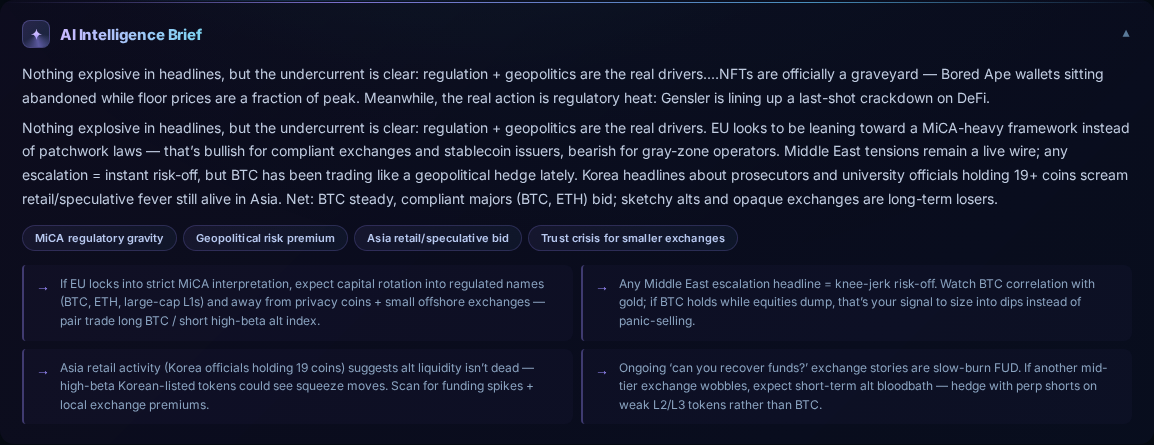
Coin-tagged, deduped, and fed directly into the per-coin signal scores. You don't read the news to find trades, you read it to pressure-test the ones the data is already suggesting. Start a free 7-day trial, no credit card required. £14.99/month while founding spots remain, £24/month after. 14-day money-back guarantee.
Related reading
- What "signal confluence" actually means (and why one signal is never enough). The discipline that replaces reactive headline trading.
- What a trade actually costs you (it's not the 0.1% on the fee page). Why every reactive trade you take is more expensive than you think.